Introduction
Most patients arrive at their hair transplant consultation with only one question in mind:
“How many grafts do I need?”
However, the truth is that this single question is one of the main reasons thousands of hair transplant procedures fail every year.
Modern hair transplantation in Istanbul is no longer just a cosmetic procedure. It has become a long-term medical planning process that focuses on designing hair distribution for the next 10–20 years, not just covering today’s baldness.
This is exactly why hair transplantation clinics in Istanbul, Turkey have become a destination for patients from Europe and the Middle East. Leading clinics do not simply sell graft numbers — they create a long-term hair restoration plan that prevents unnatural baldness in the future.
In this detailed guide, you will learn:
How doctors calculate the exact number of hair grafts scientifically
Why two patients with the same level of baldness may require completely different graft numbers
And which graft number is actually medically correct
What Is a Hair Graft?
Many patients mistakenly believe:
3000 grafts = 3000 hairs ❌
The medical reality is different.
A single hair graft (follicular unit) may contain:
1 hair (usually in the hairline)
2 hairs
3 hairs
Sometimes 4 hairs
This means 3000 grafts can produce between 7000 and 9000 hairs.
That is why experienced doctors do not only count grafts — they calculate the number of resulting hairs to achieve natural density.
Step 1: Determining the Level of Baldness
The first and most important step in planning a hair transplant is measuring the bald area accurately.
Professional clinics calculate baldness using square centimeters (cm²) rather than visual estimation.
| Baldness Level | Approximate Grafts Needed |
|---|---|
| Mild | 1500 – 2200 grafts |
| Moderate | 2500 – 3200 grafts |
| Advanced | 3500 – 4500 grafts |
| Severe | 5000 – 6500 grafts (multiple sessions) |
⚠️ A common marketing trick:
If a clinic promises 6000 grafts for moderate baldness, it often means the donor area may be overharvested and permanently damaged.
Step 2: Evaluating the Donor Area
Surprisingly, the donor area is often more important than the bald area itself.
Not every patient can safely provide the same number of grafts.
Doctors evaluate:
Graft density per cm²
Hair thickness
Root strength
Percentage of multi-hair grafts
Two patients may have the same baldness pattern:
One may need 2800 grafts
Another may require 4200 grafts
The difference usually comes from the donor area quality, not the baldness level.
Step 3: Hair Type and Its Impact on Density
Many patients do not realize that hair type dramatically affects transplant results.
| Hair Type | Visual Density Result |
|---|---|
| Curly hair | Very high density |
| Wavy hair | Excellent density |
| Straight fine hair | Requires more grafts |
For example, a skilled surgeon may transplant fewer grafts yet achieve a better visual density depending on the hair characteristics.
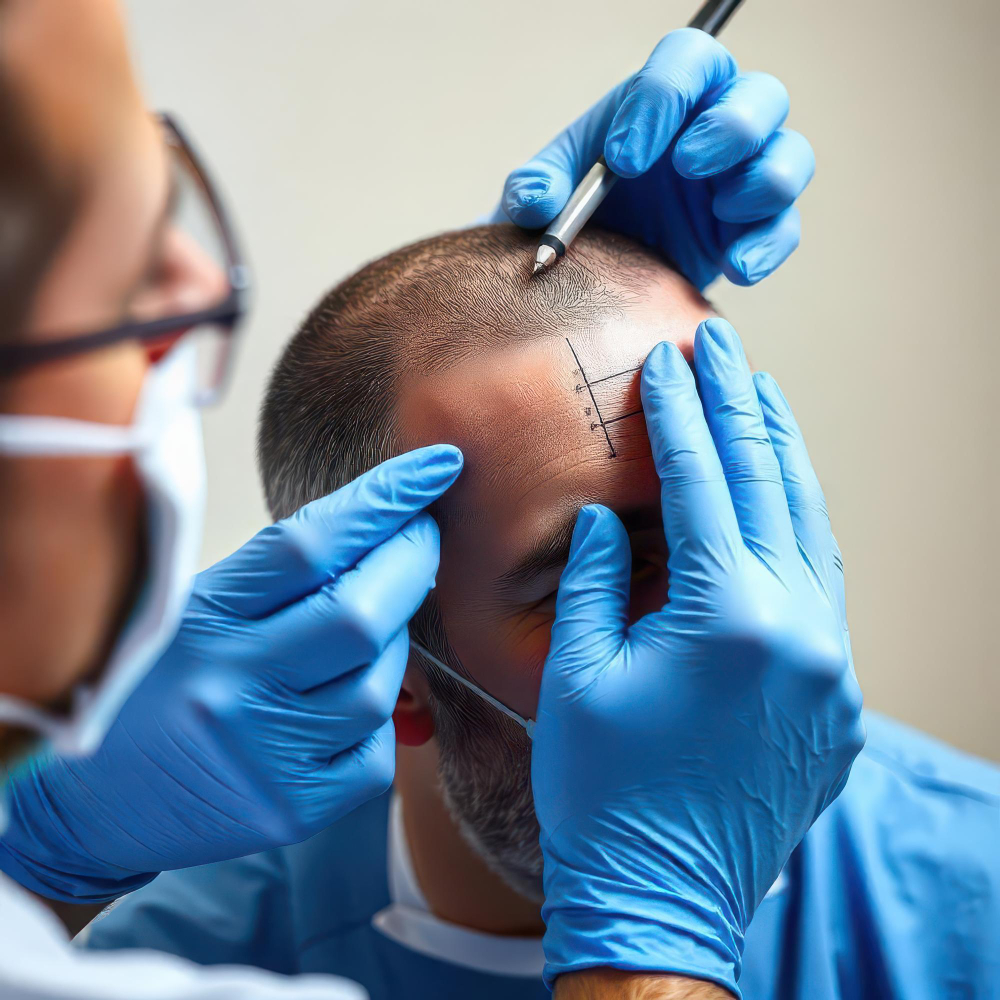
Step 4: Designing the Hairline
One of the most critical steps in a successful hair transplant is designing the hairline.
The biggest reason many hair transplants look unnatural is a hairline placed too low.
Some commercial clinics design a low hairline simply to satisfy the patient immediately.
But years later, when natural hair loss continues, the patient may be left with an isolated artificial hairline.
Experienced surgeons instead design an age-appropriate hairline that still looks natural even 10–15 years later.
Does a Higher Graft Number Mean Better Results?
Not necessarily.
5500 grafts with poor distribution → unnatural appearance
3200 grafts with proper planning → natural density
Successful hair transplantation depends on:
Implantation angle
Hair direction
Density distribution
Protection of the donor area
How Many Grafts Can Be Safely Extracted?
According to international medical guidelines:
Only 30–35% of the donor area should be harvested in a single session.
Exceeding this limit can lead to:
Permanent thinning in the donor area
Difficulty performing future procedures
Poor long-term results
For this reason, the best hair transplant clinics in Istanbul often recommend a staged approach instead of exhausting the donor area in one surgery.
How to Know If Your Graft Number Is Accurate
Before agreeing to a hair transplant, ask your doctor these questions:
What is the exact size of my bald area (cm²)?
What is my donor area density?
How many grafts should be reserved for the future?
What is the long-term hair loss plan for the next 10 years?
If these questions cannot be answered clearly, the graft number is likely a marketing estimate rather than a medical plan.
Final Thoughts
A successful hair transplant is not just a one-day procedure.
It is a lifetime strategy for managing hair loss.
Every person has a limited donor supply, and if it is used incorrectly, even the most advanced technologies may not be able to correct the result later.
This is why many patients travel to Istanbul, Turkey — one of the world’s leading destinations for hair transplant surgery.
Top clinics focus on long-term planning rather than implanting the highest possible graft number in one session.
The goal is not just to create density after 6 months, but to maintain a natural appearance after 10 or even 15 years.
Choosing a clinic that plans for your future hair loss is far more important than choosing a clinic that simply advertises the highest graft numbers.