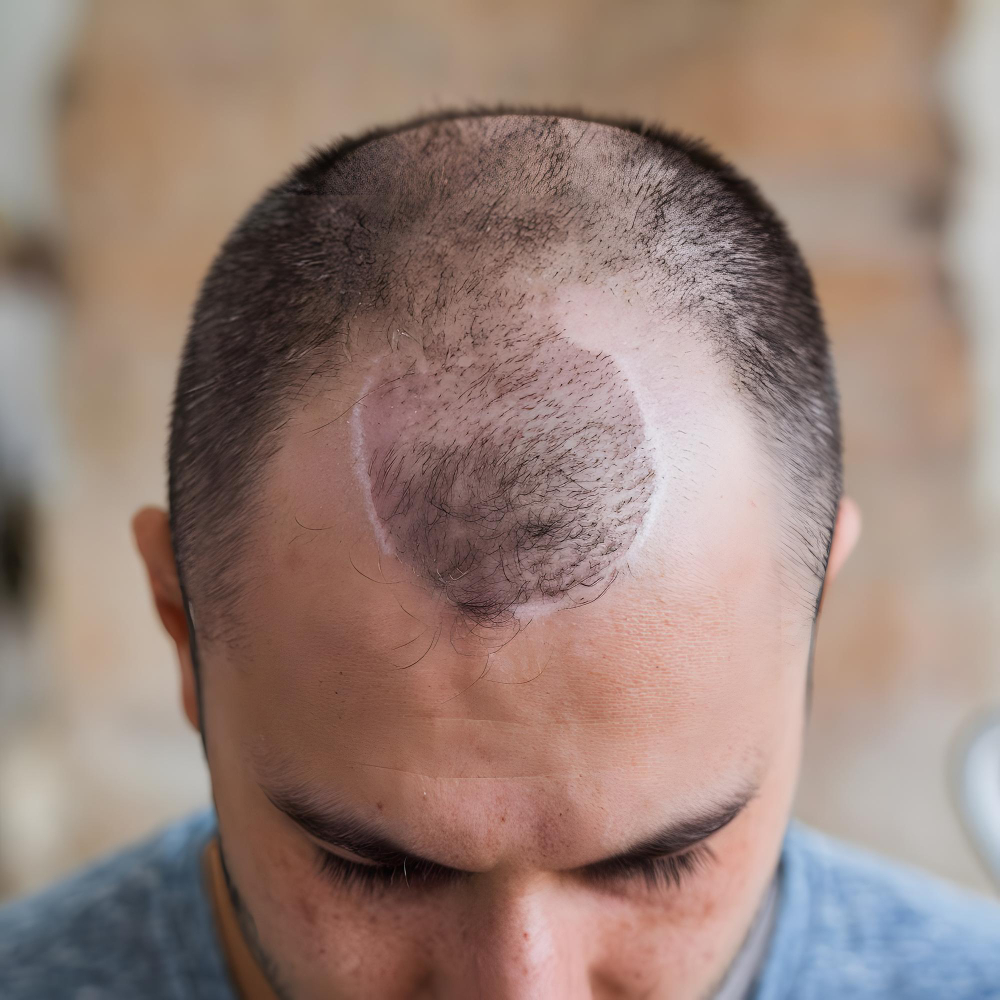
Hair Transplant Over Scars: Blood Supply, Density and Success Rate
Can hair follicles grow inside scar tissue where natural hair follicles are no longer present? Yes. Hair transplantation can be used to reduce the visibility of certain scalp scars caused by injuries, burns and previous surgical procedures. However, transplanting follicles into scar tissue differs from transplantation into normal scalp skin in terms of blood supply, tissue characteristics, graft density and the predictability of hair growth.
At our hair transplant clinic in Turkey , a scar is not treated simply as an empty area that requires a certain number of grafts. The type and stability of the scar, its thickness, flexibility, blood supply and the available donor area are evaluated before a transplantation plan is designed.
Can Hair Transplantation Over Scars Be Successful?
Hair follicles can grow within many types of scars, but graft survival and final density are generally less predictable than transplantation into normal skin. One of the most important factors is whether the scar tissue can provide an adequate blood supply to the grafts after implantation. For this reason, a conservative density is often preferred instead of aggressive dense packing. Some patients may require more than one session to achieve satisfactory cosmetic coverage. The type of scar and the stability of its underlying cause are also important. A stable traumatic scar is very different from inflammatory scarring alopecia that may become active again.
What Is Scar Hair Transplantation?
Scar Hair Transplantation involves harvesting hair follicles from a stable donor area and transplanting them into or around scar tissue so that newly growing hair can pass through the scar and reduce the visible contrast between the scar and the surrounding skin.
In most cases, the purpose is not to remove the scar itself. The scar remains underneath the hair, while the newly transplanted follicles help camouflage it visually and reduce the appearance of a hairless area.
The technique may be considered for different types of scars, including scars caused by injuries, surgical procedures, burns and previous hair transplant procedures.
What Types of Scars May Be Suitable for Hair Transplantation?
Accident and Injury Scars
Old injuries may leave areas without follicles on the scalp, eyebrow or beard. Hair transplantation may be considered after the scar has fully stabilized.
Burn Scars
Burns can destroy hair follicles and create scars with different levels of thickness and vascularity. These areas therefore require careful evaluation before selecting graft density.
FUT Scars
In selected cases, FUE follicles may be implanted into the linear scar left after strip harvesting to make it less visible, especially when the hair is cut short.
Scars From Head Surgery
Certain surgical procedures can leave lines or areas without hair. If the tissue is suitable, transplanted follicles may help camouflage these areas.
Facelift Scars
Scars close to the temple or hairline may become visible after surgery. In selected cases, hair transplantation may help reconstruct the surrounding hair.
Stable Scarring Alopecia
Certain types of scarring alopecia may be considered for transplantation following a sufficiently long period of stability. However, the possibility of disease recurrence makes proper diagnosis and follow-up particularly important.
Why Is Blood Supply So Important in Scar Hair Transplantation?
After a transplanted follicle is placed in its new location, it must interact with the surrounding tissue and obtain adequate blood supply to survive, recover and eventually enter a new growth cycle.
Normal skin contains a vascular network capable of supporting the surrounding tissue. Inside scar tissue, however, the situation may differ because of fibrosis and tissue remodeling that occurred during wound healing.
This explains why two scars that look similar in size may produce very different transplantation outcomes.
What Does Good Scar Vascularity Mean?
It means that the tissue has sufficient capacity to supply blood to the transplanted area and support the new follicles.
Several clinical characteristics may be considered when evaluating the scar, including its color, thickness, flexibility and behavior when recipient sites are created.
How Is Scar Blood Supply Evaluated Before Hair Transplantation?
There is no reliable home test that allows a patient to determine whether a scar has “adequate blood supply.”
Evaluation depends on clinical examination as well as the type, history, cause and current condition of the scar.
In selected cases, the physician may consider test grafts by transplanting a limited number of follicles first and evaluating how the tissue responds before treating a larger area.
What Is the Appropriate Hair Transplant Density Inside a Scar?
This is one of the most important differences between transplanting hair into normal scalp skin and transplanting hair into scar tissue.
The goal is generally not to place the maximum possible number of grafts into every square centimeter of scar tissue.
Increasing the number of recipient sites also increases the number of follicles that depend on the blood supply available within that area.
| Factor | Normal Scalp | Scar Tissue |
|---|---|---|
| Blood Supply | Usually more predictable in healthy skin | May be reduced or uneven |
| Tissue Flexibility | Usually better | The tissue may be harder or more fibrotic |
| Dense Packing | Higher densities may be possible depending on the case | A more conservative approach is generally preferred |
| Predictability of Graft Survival | Generally more predictable | May vary considerably between patients and scars |
| Number of Sessions | Depends largely on the area of hair loss | Treatment may sometimes be divided into several sessions |
Is 20–25 Grafts/cm² an Appropriate Density for Scar Tissue?
Some clinical studies and reviews have used relatively conservative densities of approximately 20–25 follicular units per cm² in scar transplantation.
However, this should not be interpreted as a mandatory number or a universal formula for every patient. A physician may choose a different density depending on the scar type, thickness, size, expected blood supply, hair characteristics and location.
Using one fixed number for every scar ignores one of the most important principles of scar hair transplantation: the biological environment differs from one scar to another.
Learn More About Natural Hair Transplant Density
Discover how graft numbers, hair characteristics, donor capacity and recipient-site planning influence natural-looking hair transplant density.
Why Is Very High Density Usually Avoided During the First Scar Transplant Session?
The goal is not simply to insert follicles into the skin. They must remain viable long enough to establish long-term growth.
If vascularity is limited, placing an excessive number of grafts within a small area does not necessarily produce greater final density.
For this reason, a safer strategy in selected cases may involve:
- Transplanting a conservative initial density.
- Waiting for follicular growth and assessing survival.
- Re-evaluating the scar after the result has stabilized.
- Adding a second session if the tissue permits.
What Is the Success Rate of Hair Transplantation Over Scars?
There is no single success percentage that applies to every type of scar.
Some studies involving traumatic and surgical scars have reported good graft survival rates, while results can be less predictable in some forms of scarring alopecia or in tissue with poor vascularity.
These figures are not a guarantee of an individual result. One patient may achieve a higher survival rate while another may experience less growth.
The key consideration is the condition of the scar itself rather than treating a published average as a promise of outcome.
What Factors Determine Follicle Survival Inside Scar Tissue?
Scar Vascularity
The quantity and quality of the blood supply are among the most important factors influencing the recipient environment.
Scar Type
A stable traumatic scar differs considerably from a scar caused by an ongoing inflammatory condition.
Tissue Thickness
Thick, fibrotic scars can present different challenges from flat, flexible scars.
Transplant Density
Conservative planning may be more appropriate than dense packing when the tissue has limited blood supply.
Graft Quality
Protecting grafts during extraction, preparation and implantation can affect their ability to survive.
Postoperative Care
Protecting the grafts, avoiding trauma and following recovery instructions are especially important when follicles are transplanted into scar tissue.
Considering a Hair Transplant in Turkey?
Learn about evaluation, donor-area planning, graft extraction and hair transplant techniques before making your decision.
Can Hair Be Transplanted Into an FUT Scar?
Yes. In selected patients, follicles extracted using FUE may be transplanted into the linear scar created by a previous FUT procedure.
The objective is to make hair grow through the scar line so that the contrast between the scar and surrounding hair becomes less noticeable.
However, the result depends on the width, thickness and blood supply of the scar, the density of the surrounding hair and the amount of donor hair still available.
Does an FUT Scar Completely Disappear After Hair Transplantation?
No. Hair transplantation does not anatomically remove the scar tissue. Instead, it adds growing hair within the scar to help camouflage it.
The line may become substantially less visible after the hair grows, but the scar itself remains present.
Can Hair Be Transplanted Over a Burn Scar?
Some burn scars can be treated using hair transplantation, but careful evaluation is required because the depth of the burn and the way the skin healed can affect scar thickness, blood supply and flexibility.
Some burn scars are flat and stable, while others may be thick, contracted or irregular.
Therefore, suitability for transplantation cannot be determined solely from a photograph or from the size of the scar.
What About Hair Transplantation for Scarring Alopecia?
This category requires greater caution.
In Primary Cicatricial Alopecia, hair loss is associated with a disease that affects the follicular unit and causes permanent scarring.
If the disease remains active, transplanting new follicles into the affected area does not eliminate the underlying process that destroyed the original follicles.
The underlying cause of the alopecia should therefore be diagnosed and the condition should be stable before surgery is considered.
When Should Hair Transplantation Over a Scar Be Delayed?
- When an active inflammatory disease is suspected.
- When the scarred area or surrounding hair loss continues to expand.
- When redness or other symptoms raise doubts about disease stability.
- When the donor area is insufficient.
- When the patient expects the scar to disappear completely.
- When clinical evaluation indicates that the tissue is unsuitable for transplantation.
Is FUE Better for Hair Transplantation Over Scars?
FUE allows individual follicular units to be extracted and then used to cover a specific scarred area.
This makes it a common option in scar repair, particularly when the objective is to place a carefully calculated number of follicular units within a surgical line or relatively small scar.
However, successful transplantation into scar tissue does not depend solely on the name of the extraction technique. Clinical assessment, blood supply, recipient-site density, graft quality and coverage design are often more important.
Does DHI Increase the Success Rate of Hair Transplantation Into Scars?
Using a particular implantation pen cannot suddenly improve the blood supply of scar tissue.
The method used to insert grafts may be one component of the surgical technique, but the biological environment of the scar remains a key factor in determining whether it can support transplanted follicles.
Marketing claims that reduce the success of scar hair transplantation simply to the terms FUE or DHI should therefore be viewed cautiously.
How Is the Number of Grafts Needed to Cover a Scar Calculated?
The calculation is not based only on scar length.
The physician must consider:
- The surface area of the scar in square centimeters.
- Whether its shape is linear, circular or irregular.
- The density that can safely be implanted.
- The contrast between skin color and hair color.
- The thickness and diameter of donor hair.
- The angle and direction of surrounding hair.
- Whether the goal is complete-looking coverage or simply to make the scar less visually noticeable.
Why Is Hair Shaft Thickness Important?
Visual coverage does not depend on graft numbers alone. Thicker or wavy hair can create a different coverage effect than very fine, straight hair.
For this reason, two patients with scars of the same size may require completely different treatment plans.
Learn More About Head Hair Transplantation
Read about donor-area assessment, graft numbers and the different stages of head hair transplantation in Turkey.
Can Hair From Another Person Be Used for Scar Hair Transplantation?
Standard hair transplantation uses the patient's own follicles. Hair follicles from another person are generally not used as a routine donor source because transplanted foreign tissue can be recognized by the immune system.
Patients who are concerned about limited donor hair should first have their own donor area carefully evaluated and discuss realistic coverage strategies before considering alternative ideas.
Can Hair Be Transplanted From Another Person?
Learn why modern hair transplantation normally uses the patient's own follicles and what happens when donor hair is limited.
Does Scar Hair Transplantation Require One Session or More?
Some small scars may achieve satisfactory cosmetic coverage after one session, whereas other scars may require an additional procedure.
This does not necessarily mean that the first procedure has “failed.”
In some cases, conservative planning is intentional from the beginning to avoid placing an excessive number of grafts into tissue with limited vascularity.
Once the actual growth and survival of the transplanted follicles are known, additional density may be added where required.
What Happens to Hair Follicles After They Are Transplanted Into a Scar?
Does Hair Grow More Slowly in Scar Tissue Than in Normal Skin?
Scarred areas can respond differently from one patient to another. For this reason, every centimeter of transplanted scar tissue should not be directly compared with normal scalp skin treated during the same procedure.
Some follicles may grow very well while survival may be lower in other parts of the scar depending on local tissue characteristics.
Success should therefore be evaluated after enough time has passed, rather than judging the result simply from the first appearance of new hairs.
Can Transplanted Hair Improve the Appearance of the Scar Tissue Itself?
The primary objective of the procedure is to cover the scar with hair.
However, small recent studies have also investigated whether changes in scar tissue may occur after follicular transplantation, including remodeling of certain components of fibrotic tissue.
These findings are scientifically interesting, but they do not mean that hair transplantation is a guaranteed treatment for removing scars.
The realistic expectation should be improved coverage and visual camouflage of the scar, rather than restoration of the skin to its condition before the scar developed.
Does PRP Increase the Success of Hair Transplantation in Scar Tissue?
Several techniques have been studied in an effort to improve the biological environment of scar tissue, including PRP, fat grafting, Nanofat and other regenerative approaches.
Some research has reported promising findings for selected techniques and patients, but the available evidence should not be presented as a guarantee that all transplanted follicles will survive.
Any additional treatment should be selected according to the scar type, clinical condition and available medical evidence.
Can Beard Hair Be Used for Scar Hair Transplantation?
In selected scalp scar repair procedures, beard hair may be considered as an additional donor source, especially when the scalp donor supply is limited.
Beard hair generally differs from scalp hair in thickness, texture and growth cycle, so its distribution should be carefully planned to maintain an aesthetically natural result.
In a highly visible area, the characteristics of the donor hair may be just as important as the number of follicles transplanted.
Hair Transplantation or Scalp Micropigmentation for Scar Camouflage?
The two approaches are different.
| Factor | Hair Transplantation | SMP |
|---|---|---|
| Result | Real hair grows from transplanted follicles | Pigmentation simulates the appearance of short follicles |
| Donor Area Required | Yes | No donor follicles are required |
| Scar Suitability | Depends on blood supply and tissue characteristics | Cosmetic success depends on scar characteristics and skin tone |
| Long Hair | Hair grows naturally and can be cut | Does not produce real hair |
| Combined Use | In selected patients, both methods may be combined to improve visual camouflage. | |
Can a Scar Be Transplanted Again After a Poor Initial Result?
Sometimes, yes. However, the reason for the low density should first be identified.
If the problem is related to scar vascularity or tissue quality, simply repeating the same procedure using the same density may not solve the problem.
Existing growth, remaining uncovered areas, scar condition and the donor area should be reassessed before deciding whether a second procedure is reasonable.
How Is Hair Transplantation Planned for a Large Scar?
Large scars require careful prioritization.
When donor hair is limited, attempting to restore natural density to every square centimeter may not be realistic.
Hair direction may instead be designed to provide the greatest visual coverage with the fewest possible follicles, giving priority to the scar edges and the areas that are most visible.
What Is the Difference Between Graft Survival and Cosmetic Success?
This is an important distinction.
Graft Survival refers to the percentage of transplanted follicles that survive and begin producing hair.
Cosmetic Success refers to how effectively that hair makes the scar less noticeable.
A relatively modest number of follicles producing thick hairs and positioned at the correct angles may provide excellent camouflage. Conversely, greater density may still appear unnatural if hair direction and distribution are poorly designed.
What Are the Signs of Successful Hair Transplantation Over a Scar?
- Gradual appearance of new hair within the scarred area.
- Reduced visual contrast between the scar and surrounding hair.
- Hair direction that blends naturally with adjacent hair.
- No obvious areas of pluggy-looking growth.
- Stable tissue without signs of newly active inflammatory disease.
- The ability to cut and style the hair in a way that makes the scar less noticeable.
Recovery After Hair Transplantation Into Scar Tissue
Care of the recipient area is important after every hair transplant and becomes particularly important when grafts have been implanted into scar tissue that may have different elasticity and vascularity from normal skin.
Patients should follow the medical team's instructions regarding washing, sleeping position, touching the transplanted area, physical activity and prescribed medications.
Scabs should not be scratched or forcibly removed, and the grafts should not be manipulated manually.
What Questions Should You Ask Before Hair Transplantation Over a Scar?
- What caused the scar?
- Is the scar stable or is it still changing?
- Are there signs of active inflammatory disease?
- Is the blood supply of the tissue suitable for transplantation?
- What density is recommended and why?
- Approximately how many grafts will be required?
- Is the donor supply sufficient?
- Am I likely to require a second session?
- Is the objective to remove the scar or camouflage it?
- Are alternatives such as SMP or surgical scar revision appropriate?
Can a 90% or 100% Success Rate Be Guaranteed for Scar Hair Transplantation?
A fixed success rate should not be guaranteed for every patient.
Published studies demonstrate substantial variation in follicular survival within scar tissue. This is understandable because scar hair transplantation does not represent one single biological condition.
A thin, flat surgical scar is very different from a large burn scar or a scar associated with inflammatory disease.
Individual evaluation is therefore much more valuable than a fixed marketing percentage.
Be Careful With Exaggerated Guarantees
Statements such as “we guarantee that every graft will grow in any scar” do not reflect the variable biological nature of scar tissue. Success depends on the condition and blood supply of the scar, donor-area quality, surgical planning and postoperative care.
Conclusion: Is Hair Transplantation Over Scars Worth Considering?
Hair transplantation can be a highly effective method for camouflaging certain scars, but it requires a different strategy from conventional transplantation for pattern hair loss.
One of the most important factors is whether the scar can support the transplanted follicles through adequate vascularity. Density should therefore not be treated as the only objective.
In many patients, it is preferable to build the result gradually: begin with carefully planned density, evaluate actual growth and add another session if necessary rather than attempting extremely high density during the first procedure.
The cause of the scar must also be understood. A stable surgical scar is completely different from a scarring alopecia disorder that may reactivate.
At our hair transplant clinic in Turkey , the scar, donor area, blood supply and achievable density are evaluated before a treatment plan is designed. The aim is to achieve the most natural possible camouflage while protecting both the transplanted follicles and the donor area.
Selected Medical References
- International Society of Hair Restoration Surgery (ISHRS): Hair Restoration in the Scarred Scalp.
- Singh S, et al. Role of Hair Transplantation in Scarring Alopecia—To Do or Not to Do?
- Yoo H, et al. Treatment of Postsurgical Scalp Scar Deformity Using Follicular Unit Hair Transplantation.
- Madura C, et al. Assessment of Hair Transplantation Outcomes in Cicatricial Alopecia.
- Plotczyk M, et al. Anagen Hair Follicles Transplanted into Mature Human Scars Can Remodel Fibrotic Tissue.
Do You Have a Scalp Scar and Want to Know Whether Hair Can Be Transplanted Over It?
Send your inquiry together with clear photographs of the scar for an initial evaluation. The medical team can assess whether your case may be suitable for hair transplantation and which factors should be considered before determining graft numbers and density.
WhatsApp: +90 543 916 67 62
Frequently Asked Questions About Hair Transplantation Over Scars
Answers to common questions about follicular growth inside scar tissue, blood supply, density, FUE and scar hair transplant success rates.
Can hair be transplanted over a scar?
Yes. In many stable scars, hair follicles can be transplanted into the scar tissue to camouflage the area. Suitability depends on the cause of the scar, vascularity, thickness and stability.
Does transplanted hair grow normally inside a scar?
Follicles that successfully establish themselves inside the tissue can produce real hair that grows and can be cut. However, survival rates may be less predictable than transplantation into normal scalp tissue.
What is the success rate of hair transplantation over scars?
There is no single success percentage for every patient. Some studies involving traumatic scars have reported good survival rates of approximately 78%, but results vary depending on scar type, blood supply, cause and transplantation density.
What density is appropriate for hair transplantation into scar tissue?
Some studies have used conservative densities of approximately 20–25 follicular units per cm². However, appropriate density should be determined individually for each scar rather than applying one fixed number to every patient.
Why can't scar tissue always be transplanted at very high density?
Blood supply within scar tissue may be lower or more uneven than normal skin. Excessive density may therefore increase competition among grafts for the available vascular supply.
Can hair be transplanted into an FUT scar?
Yes, in selected cases. FUE follicles can be transplanted into the linear scar produced by FUT in an effort to make the scar less visible.
Does the scar disappear after hair transplantation?
No. Hair transplantation does not remove the scar itself. It allows hair to grow through the area in order to camouflage the scar and make it less noticeable.
Can hair be transplanted over burn scars?
Some burn scars may be suitable for transplantation, but their depth, thickness, flexibility, vascularity and stability should be evaluated before treatment.
Can hair transplantation be performed for scarring alopecia?
Transplantation may be possible in selected cases of stable scarring alopecia. However, disease inactivity should be confirmed because recurrence of the condition may cause loss of transplanted follicles.
Will I need more than one session?
Some patients achieve satisfactory results after one session, while other scars may require a second procedure to add density after growth from the first session has been evaluated.
Is FUE better for repairing hair transplant scars?
FUE allows individual follicles to be extracted and transplanted into scar tissue and is therefore frequently used to repair FUT scars. However, the result depends on scar characteristics, blood supply and planning rather than the name of the technique alone.
When does transplanted hair begin growing inside a scar?
Follicles typically pass through stages similar to other hair transplants. New hairs may begin appearing gradually during the months following surgery, while assessment of the mature result requires more time.
Can the growth of every transplanted follicle be guaranteed?
No. Scar tissue is more biologically variable than normal skin, so a fixed survival percentage cannot be guaranteed for every patient. The outcome depends on vascularity, scar type and cause, surgical technique and postoperative care.